



YouTube has quietly become one of the most powerful wealth-creation platforms on the internet. With over 2.53 billion monthly active users and a creator economy that paid out more than $70 billion to partners between 2021 and 2023 alone, the platform is no longer just a place to watch videos. It is a legitimate business opportunity for anyone willing to put in the work. The question every aspiring creator asks is the same: which niches actually pay? What are the most profitable YouTube channel niches?
Finding the right YouTube channel ideas to make money comes down to understanding three things: advertiser demand, audience purchasing power, and competition levels. A niche with a massive viewer base but low advertiser interest will never match a smaller, targeted niche where brands are willing to pay premium rates to reach the audience. This is where CPM and RPM become the most important numbers in the room.

This article breaks down the top 10 most profitable YouTube channel niches, backed by real CPM and RPM data, real creator earnings, and actionable advice on how to enter each one. Whether you are building a faceless channel, launching a side hustle, or replacing a full-time income, these niches represent the best opportunities available right now.
What you need to know about YouTube monetization
Before picking a niche, you need to understand how YouTube pays creators. According to YouTube’s official support page, the YouTube Partner Program (YPP) remains the primary gateway to monetization. The requirements are:
- Standard Tier: 1,000 subscribers + 4,000 public watch hours in 12 months, OR 10 million Shorts views in 90 days.
YouTube takes a 45% cut of ad revenue. You keep the remaining 55%. That means your RPM not CPM is the number that determines your actual income.
For example, a niche with a $20 CPM gives you roughly $11 RPM after YouTube’s share. Keep that math in mind as we go through each niche below.
The top 10 most profitable YouTube niches
1. Personal finance and Investing
CPM range: $12–$50 | RPM range: $10–$25
This is, without question, the highest-paying niche on YouTube. Financial services advertisers, banks, brokerages, fintech companies, and credit card firms compete fiercely for viewer attention, driving CPM rates that dwarf almost every other category. Finance CPMs can reach $50 for well-positioned creators targeting US audiences.
Why it pays so much
Viewers searching for finance content are in active “buying mode.” They are researching investments, comparing credit cards, or evaluating financial products. Advertisers pay top dollar to be in front of that audience. Graham Stephan, a personal finance YouTuber with nearly 5 million subscribers, reportedly earns over $163,000 monthly from YouTube alone.
Content ideas
- Budgeting guides
- Investing for beginners
- Credit card comparisons
- Tax strategy breakdowns
- “How to save X per month” videos.
Sub-niche opportunity
Rather than competing in broad “personal finance,” target underserved segments like “investing for freelancers” or “financial planning for single parents.” These sub-niches maintain high CPMs with significantly less competition.
2. Technology reviews and tutorials
CPM range: $8–$40 | RPM range: $3–$12
Tech is one of the most evergreen niches on YouTube. New gadgets, software updates, and devices launch constantly, giving you a never-ending content pipeline. Tech review channels like Marques Brownlee (MKBHD) with 20 million subscribers earn between $13,600 and $200,000 per month from ads alone.
Why it pays
Tech products are high-ticket. A single affiliate commission on a laptop or phone can outperform weeks of ad revenue from lower-value niches.
Content ideas
- Gadget unboxings
- Software walkthroughs
- “Best tech under $X” roundups
- Troubleshooting guides
- Comparison videos.
Faceless potential
Screen recordings and voiceovers work exceptionally well here, making it one of the best niches for creators who prefer to stay off camera.
3. Business and Entrepreneurship
CPM range: $15–$30 | RPM range: $8–$15
B2B content commands premium ad rates because the audiences are professionals with real spending authority. Advertisers in SaaS, marketing tools, and business services pay heavily to reach entrepreneurs and business owners. B2B content consistently delivers CPMs between $15 and $30.
Content ideas
- How to start specific types of businesses
- Marketing strategy breakdowns
- Productivity systems
- Ecommerce tutorials
- Leadership lessons.
Growth hack
Pair your content with affiliate links to business tools like Shopify, Pushbio, Kajabi, or ClickFunnels. These affiliate programs offer high commissions and align naturally with your audience.
4. Health, Wellness, and Fitness
CPM range: $8–$20 | RPM range: $5–$12
Health content attracts massive audiences and consistent advertiser interest. Supplement companies, fitness apps, and wellness brands spend heavily on YouTube ads. Mental health and wellness channels in particular are seeing significant earning growth as the industry expands.
Content ideas
- Workout routines
- Meal prep guides
- Mental health awareness content
- Sleep optimization
- Chronic illness management.
Important note
YouTube enforces strict health content policies. Always include disclaimers and avoid making medical claims. Credibility and accuracy protect both your audience and your channel’s monetization status.
5. Education and E-Learning
CPM range: $10–$25 | RPM range: $6–$14
Educational content is a powerhouse because it attracts viewers who are actively trying to learn something and advertisers know that learners are also buyers. Online course platforms, tutoring services, and EdTech companies pour money into this space. According to Lenos, educational videos have a significantly higher CPM than entertainment content.
Content ideas
- Language learning
- Exam preparation
- Skill-building tutorials (coding, design, writing)
- Explainer videos on complex topics.
Scalability
Education content performs exceptionally well as evergreen material. A video teaching “how to learn Python” continues earning views and revenue for years after upload.
6. AI Tools and Automation
CPM range: $10–$25 | RPM range: $7–$15
This is the fastest-growing niche on YouTube as of now. As AI tools become mainstream, demand for content that explains, compares, and teaches these tools is exploding. AI tools education is one of the top emerging high-CPM categories, with growing advertiser interest as AI companies launch new products.
Content ideas
- AI tool reviews
- Prompt engineering guides
- Workflow automation tutorials
- “AI vs human” comparisons
- Productivity hacks using AI.
Why it’s the right time to enter
Competition is still manageable compared to established niches. Early movers who build authority now will dominate as the niche matures.
7. Real Estate and Property
CPM range: $10–$20 | RPM range: $8–$10
Real estate advertisers, mortgage lenders, agents, property platforms pay premium rates to reach potential buyers and investors. The audience in this niche tends to be older and wealthier, which means higher advertiser bids across the board.
Content ideas
- Property investment guides
- Market analysis
- First-time buyer walkthroughs
- Rental property calculators
- House-hunting vlogs.
Affiliate opportunity
Linking to real estate platforms, mortgage calculators, or property management tools adds a meaningful second income stream beyond ad revenue.
8. Legal and Court Content
CPM range: $9–$15 | RPM range: $7–$9
This niche punches well above its weight in terms of CPM. Legal services advertisers like family lawyers, immigration attorneys, criminal defense firms bid aggressively for attention. Legal and court content is among the top RPM performers with manageable competition levels.
Content ideas
- Court case breakdowns
- Legal explainers
- “Know your rights” guides
- Commentary on high-profile legal cases.
Important caveat
Never present content as actual legal advice. Position yourself as an educator or commentator, and include appropriate disclaimers.
9. Insurance and Financial services
CPM range: $9–$20 | RPM range: $7–$11
Insurance companies are among the highest-spending advertisers on YouTube. They target audiences researching health, life, car, and home insurance and they pay accordingly. This niche is underserved relative to its earning potential, making it an excellent entry point.
Content ideas
- Insurance comparison guides
- “Do I need X insurance” breakdowns
- Medicare explainers
- Financial planning content that naturally incorporates insurance topics.
Audience profile
Viewers in this niche tend to be professionals aged 30–55 with real purchasing power. That demographic alone drives CPM higher.
10. DIY, Home Improvement, and Gardening
CPM range: $6–$15 | RPM range: $4–$10
Home improvement content has migrated from TV to YouTube with remarkable success. According to Teachable, channels like Garden Answer have built audiences of 1.9 million subscribers with estimated monthly earnings between $1,600 and $26,000. Hardware stores, home goods brands, and tool manufacturers advertise heavily in this space.
Content ideas
- Step-by-step renovation tutorials
- Budget home makeovers
- Gardening for beginners
- Seasonal project guides
- Product reviews.
Why it works long-term
Home improvement is evergreen. People are always buying homes, renovating kitchens, or starting gardens. This niche does not go out of style.
How to choose the right niche for your channel
Picking a niche purely based on CPM is a mistake.
The best niche for you sits at the intersection of three factors:
1. Your expertise or genuine interest
Choosing a niche you truly understand or are passionate about is one of the strongest foundations for long-term YouTube success. Experts and creators agree that passion keeps you producing content consistently. This is something essential if you want to grow over months and years rather than burn out early.
Tools like TubeBuddy highlight the importance of starting with what you know and love, then niching down within that area so your videos feel authentic and valuable to viewers. Authenticity helps keep you motivated and makes your content more engaging, because audiences can often tell when someone actually cares about the topic they’re talking about.
2. Competition vs. opportunity
Not all niches are equally easy to break into and sometimes a high-CPM niche can be very crowded. Instead of chasing only the highest ad rates, successful YouTubers look for search demand plus manageable competition. Tools like VidIQ help you compare keyword search volumes and competition levels so you can find areas where interest is strong but not so saturated that growth becomes impossible.
A niche with millions of established creators often means you’ll have to work much harder for visibility than in a niche with fewer content producers, even if the CPM is slightly lower. Smart niche research focuses on competitive gaps and underserved subtopics as well as broad category trends. This gives you space to grow while still reaching viewers.
3. Monetization beyond Ads
Relying on YouTube ad revenue alone (your CPM) is often not enough for creators who want to make a living from their channels. That’s because ads are only one part of total earnings, and CPM can fluctuate based on factors like audience location, video type, and advertiser demand. The most financially successful channels diversify their income.
Popular monetization strategies include affiliate marketing, where you earn commissions from products you recommend; sponsored content with brands looking to reach your audience; digital products or online courses related to your niche; and merchandise sales. These revenue streams often outperform ad income, especially in niches where viewers trust your expertise and are willing to invest in what you recommend.
Key strategies to maximize your YouTube earnings
Make videos longer than 8 minutes
Posting videos that are longer than 8 minutes unlocks mid-roll ads, which are ads that play in the middle of a video. These ads increase the number of total ad impressions per watch session, directly boosting your RPM (Revenue Per Mille/1,000 views).
According to creators and experts, longer videos also tend to be ranked more favorably by the YouTube algorithm if they maintain good retention. A study from UpGrowth shows that YouTube’s algorithm rewards videos that keep people watching, since this keeps users on the platform longer which ultimately means more ad money for both YouTube and creators.
2. Target tier 1 audiences
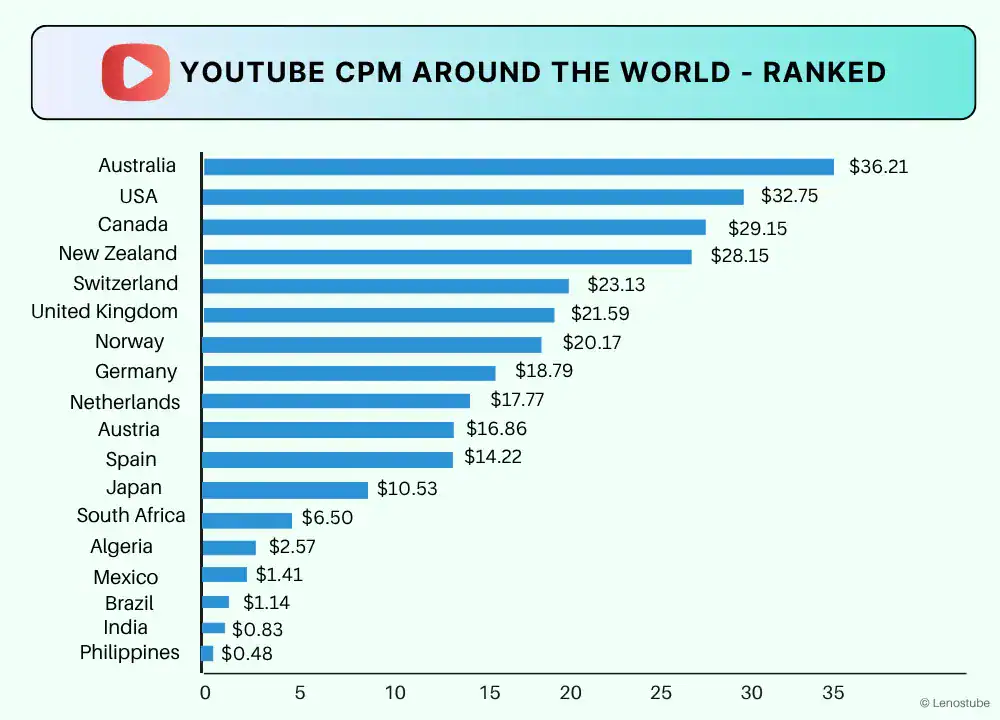
YouTube earnings vary widely depending on where your viewers are located. Tier 1 countries, especially Australia, the United States, United Kingdom, and Canada generate the highest CPM (Cost Per Mille) because advertisers are willing to pay more to reach these audiences. Research into YouTube monetization and ad rates consistently shows that Australian and US traffic often yields the highest ad payments, while audiences from other parts of the world may generate lower RPM.
To attract Tier 1 viewers, creators often:
-
- Use English-language content.
- Integrate region-relevant keywords.
- Cover topics trending in those countries.
Even creators outside these countries can earn higher revenue by designing their content with these markets in mind.
3. Plan content around Q4
Advertisers spend significantly more on ads in Q4 between October to December because of the holiday season (Black Friday, Christmas, New Year). This surge in demand pushes YouTube RPMs higher than at other times of year.
According to data from OutlierKit and creator income reports, YouTube RPM during this period can often reach $25–$40 per 1,000 monetized views, compared to much lower figures in slower quarters like Q1. Because of this, many YouTubers plan their best, highest-production-value content for Q4 to take full advantage of increased ad spending, often releasing major videos and series in this window.
4. Use Shorts strategically
YouTube Shorts are short-form vertical videos designed to compete with TikTok and Reels. While Shorts have much lower direct monetization often earning around $0.01–$0.06 per 1,000 views under many reporting estimates, they remain powerful for growth due to their huge reach.
Shorts can attract new viewers quickly and help:
- Grow your subscriber base.
- Introduce viewers to your long-form videos.
- Boost channel visibility through algorithmic recommendation.
Rather than relying on Shorts for direct earnings, smart creators use them as funnels to their higher-earning, long-form content.
5. Optimize for search, not just trends
Some content earns steadily for years, this is known as evergreen content. Tutorials, “how-to” guides, product reviews, and detailed explanations are typically evergreen, meaning they continue attracting views long after they are published. On the other hand, trending content like the newest viral challenge can spike quickly but also dies quickly.
Successful YouTubers usually balance both:
- Evergreen topics provide a long-term revenue base.
- Trending topics drive short-term spikes and visibility.
Search optimization like titles, descriptions, tags, and timestamps is essential because much of YouTube traffic comes from search rather than suggested videos. Creators who optimize for search see a steady stream of viewers and steady ad revenue over a long period.
The bottom line
YouTube is not a get-rich-quick platform, but it is a genuinely profitable one for creators who choose the right niche and stay consistent. The data is clear: finance, tech, business, education, and AI tools represent the strongest earning opportunities. Legal, insurance, and real estate niches offer high CPMs with lower competition which is perfect for creators looking for an entry point without fighting established giants.
The single most important decision you will make is which niche to enter. Pick one backed by advertiser demand, aligned with your knowledge, and sustainable over the long term. Then commit to it. Build authority. Create value. The revenue follows.