

Growing a YouTube channel from scratch to having a decent following is genuinely hard. You can spend months producing quality videos, optimizing your titles, building an upload schedule, and still watch the subscriber counter crawl. At some point, the question almost every creator asks is: Is there a faster way? Can you buy YouTube subscribers?
Technically, you can buy YouTube subscribers, as the internet is full of services offering exactly this. Hundreds of third-party services will sell you subscriber counts in bulk packages ranging from a few hundred to hundreds of thousands. However, the more useful question is what happens after you buy them. The answer depends on who you buy from, what type of accounts are delivered, and how YouTube’s systems respond to the sudden change in your metrics.

This piece is a detailed, factual breakdown of what buying YouTube subscribers actually does to your channel, including the mechanics, the risks, the policy framework, and what the research and real creator experiences show. After reading this piece, you will have a clear picture of whether this is worth considering for your specific situation, and what legitimate alternatives exist for sustainable channel growth.
Can you buy YouTube subscribers?
Yes, it is technically possible to buy YouTube subscribers from various online services. These platforms promise to quickly boost your subscriber count, making your channel appear more popular at first glance. However, while this option seems like a shortcut to growth, it comes with serious risks and limitations that can harm your channel in the long run.
What does buying YouTube subscribers mean?
When someone says they bought YouTube subscribers, they usually mean one of three things:
- They paid for bot accounts to subscribe to their channel,
- They paid for incentivized real users to subscribe (where people are paid small amounts to follow channels), or,
- They used a service running legitimate promotional campaigns through platforms like Google Ads.
These three types are not the same, and the difference matters enormously.
Bot accounts
These account types are automated, where software generates fake profiles that subscribe to your channel in large numbers. These accounts do not watch your videos, do not comment, and do not share. They are hollow numbers. Most cheap “buy subscribers” services offering 1,000 subscribers for under $20 deliver bots or incentivized accounts.
Incentivized accounts
They are real users, but they subscribed for a reward (cash, gift cards, or credits on a third-party platform) rather than a genuine interest in your content. They may be counted as real people, but they will never watch your videos.
Ad-based promotion
It is the only method that can legitimately direct real, interested viewers to your channel, and it operates through YouTube’s own advertising infrastructure. This is the legal option, but it is also more expensive, slower, and requires compelling content to convert viewers into subscribers.
Is buying subscribers allowed on YouTube?
No, buying subscribers goes directly against YouTube’s Terms of Service which clearly states that users are prohibited from engaging in behavior that will “cause or encourage any inaccurate measurements of genuine user engagement with the Service, including by paying people or providing them with incentives to increase a video’s views, likes, or dislikes, or to increase a channel’s subscribers, or otherwise manipulate metrics in any manner.”
YouTube’s Fake Engagement Policy adds further detail, clarifying that “page traffic found to be artificial will not be counted on YouTube and can lead to strikes on your account.” The policy also states that “terminated accounts and subscribers that are identified as spam will not count toward your total number of subscribers or views.”
The Channel Monetization Policies go even further for creators in the YouTube Partner Program (YPP): “creators should not artificially inflate a channel’s engagement, such as views, subs, likes, watch time, and ad impressions. Engaging in this type of behavior may result in removal from the YouTube Partner Program or termination of your channels.”
YouTube is designed to reward authentic engagement, meaning real people watching, liking, and interacting with your content. Any attempt to artificially inflate your numbers, including purchasing subscribers, is considered a violation of these rules. This puts your channel at risk from the moment you engage in such practices.
How does YouTube detect bought subscribers?
YouTube’s detection systems have become significantly more sophisticated since 2022, and they operate on multiple layers simultaneously. While the company does not reveal every detail of its detection methods, there are several clear ways it identifies suspicious activity.
1. Engagement pattern analysis
When subscribers arrive in bulk from third-party services, YouTube’s systems compare the subscriber growth against corresponding changes in watch time, click-through rates, and engagement rates (likes, comments, shares). A channel that gains 5,000 subscribers in 48 hours but shows no corresponding increase in watch time raises an immediate red flag. Genuine subscriber growth always correlates with increased viewing behavior.
2. Behavioral signals from accounts
YouTube analyses the behavior of subscribing accounts, whether they have profile photos, whether they have watched videos on other channels, whether they have any engagement history, and what IP addresses they originate from. Bot farms and click farms often generate accounts from clusters of the same IP range, making them identifiable regardless of how they are packaged by the service provider.
3. Repetitive or automated activity
If multiple subscriptions come from accounts showing identical or automated behavior, such as subscribing to hundreds of channels in a short time, YouTube can detect this pattern. Real users do not behave this way, so repeated or robotic actions are a strong indicator of manipulation.
4. Third-party service monitoring
YouTube keeps track of known services that sell fake engagement. When accounts are linked to these services, they can be flagged more easily. Channels that interact with these networks may also be monitored more closely for suspicious growth patterns.
What does YouTube do to accounts that buy subscribers?
If YouTube detects that a channel is buying subscribers, it doesn’t just ignore it. The platform takes a range of actions designed to remove fake growth and protect real creators. The severity depends on how serious or repeated the violation is.
1. AI-powered periodic purges
YouTube does not just flag suspicious accounts in real time; it also runs regular clean-up sweeps that remove inactive, spam, and bot accounts across the platform. These purges are not announced in advance and can remove purchased subscribers days, weeks, or months after delivery. A creator who bought 3,000 subscribers might lose 2,800 of them in a single overnight purge without any direct notification.
2. The strike and warning system
YouTube’s Community Guidelines enforcement operates on a three-strike system. A first violation results in a warning with no penalty to the channel. A second violation produces a one-week upload restriction. A third violation within 90 days triggers permanent channel termination. For fake engagement specifically, YouTube can also act at the channel level without going through the strike system by applying reduced visibility or demonetization directly.
3. Channel suspension or termination
For severe or repeated abuse, YouTube can suspend or permanently delete your channel. This is the worst-case scenario, where you lose all your content, subscribers, and progress. Recovering from this is extremely difficult, if not impossible.
4. Ongoing monitoring
Even if your channel is not immediately penalized, it may be placed under closer review. Future activity will be scrutinized more carefully, making it harder to grow or regain trust on the platform.
Why you shouldn’t consider buying YouTube subscribers
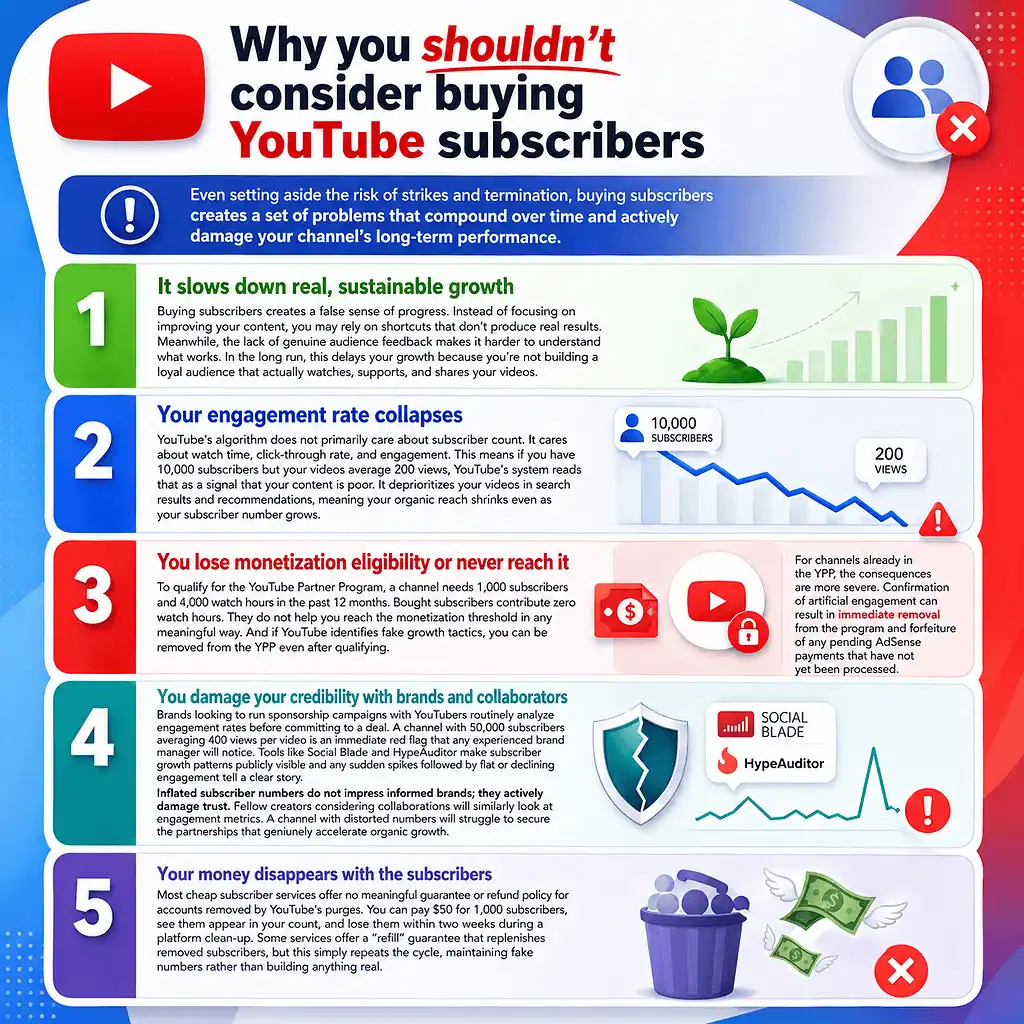
Even setting aside the risk of strikes and termination, buying subscribers creates a set of problems that compound over time and actively damage your channel’s long-term performance.
1. It slows down real, sustainable growth
Buying subscribers creates a false sense of progress. Instead of focusing on improving your content, you may rely on shortcuts that don’t produce real results. Meanwhile, the lack of genuine audience feedback makes it harder to understand what works. In the long run, this delays your growth because you’re not building a loyal audience that actually watches, supports, and shares your videos.
2. Your engagement rate collapses
YouTube’s algorithm does not primarily care about subscriber count. It cares about watch time, click-through rate, and engagement. This means if you have 10,000 subscribers but your videos average 200 views, YouTube’s system reads that as a signal that your content is poor. It deprioritizes your videos in search results and recommendations, meaning your organic reach shrinks even as your subscriber number grows.
3. You lose monetization eligibility or never reach it
To qualify for the YouTube Partner Program, a channel needs 1,000 subscribers and 4,000 watch hours in the past 12 months. Bought subscribers contribute zero watch hours. They do not help you reach the monetization threshold in any meaningful way. And if YouTube identifies fake growth tactics, you can be removed from the YPP even after qualifying.
For channels already in the YPP, the consequences are more severe. Confirmation of artificial engagement can result in immediate removal from the program and forfeiture of any pending AdSense payments that have not yet been processed.
4. You damage your credibility with brands and collaborators
Brands looking to run sponsorship campaigns with YouTubers routinely analyze engagement rates before committing to a deal. A channel with 50,000 subscribers averaging 400 views per video is an immediate red flag that any experienced brand manager will notice. Tools like Social Blade and HypeAuditor make subscriber growth patterns publicly visible, and any sudden spikes followed by flat or declining engagement tell a clear story.
Inflated subscriber numbers do not impress informed brands; they actively damage trust. Fellow creators considering collaborations will similarly look at engagement metrics. A channel with distorted numbers will struggle to secure the partnerships that genuinely accelerate organic growth.
5. Your money disappears with the subscribers
Most cheap subscriber services offer no meaningful guarantee or refund policy for accounts removed by YouTube’s purges. You can pay $50 for 1,000 subscribers, see them appear in your count, and lose them within two weeks during a platform clean-up. Some services offer a “refill” guarantee that replenishes removed subscribers, but this simply repeats the cycle, maintaining fake numbers rather than building anything real.
Legitimate alternatives to buying YouTube subscribers
Subscriber count can look impressive, but on its own, it doesn’t mean much. It’s more of a surface-level metric than a true measure of success. What really matters on YouTube is how people interact with your content, not just how many people clicked the subscribe button at some point.
If the underlying goal is to grow faster, several approaches deliver real results without risking your channel’s future:
1. YouTube Ads (Google Ads for Video)
Running paid campaigns through YouTube’s own ad platform is the one form of “paid growth” that is entirely compliant with YouTube’s terms. You target real users who match your audience profile, and the subscribers who come through these campaigns actually watched your content and chose to subscribe. Costs range from $0.01 to $0.30 per view, depending on targeting.
2. Use YouTube Shorts
Short-form vertical video remains one of the highest-velocity organic growth tools on the platform. Shorts receive preferential algorithmic distribution to non-subscribers and can reach new audiences rapidly. Many creators have grown from 0 to 10,000 subscribers through Shorts alone without any paid promotion.
3. Collaborations and cross-promotion
Appearing on channels in your niche or complementary niches exposes your content to audiences already interested in your topic. A well-matched collaboration can deliver hundreds of genuine new subscribers with high retention per video.
4. Consistent SEO-optimized uploads
Optimizing video titles, descriptions, and tags for search intent, posting on a consistent schedule, and creating content around high-demand topics with manageable competition remains the most reliable long-term strategy available to any creator.
5. Community engagement
Responding to every comment and asking questions in your videos signals quality to the algorithm while growing word-of-mouth organically. Viewers who feel engaged by a creator are far more likely to become active, loyal subscribers than any purchased list could produce.
In the end
Can you buy YouTube subscribers? Yes. Should you? Almost certainly not. The upside is a temporary number on a page that does not translate into views, watch time, monetization, brand trust, or algorithm reach. The downside is the risk of strikes, demonetization, termination, and permanent damage to the channel metrics that actually determine your long-term success.
For creators who want to build sustainable, monetized YouTube channels, doing it through genuine content, smart SEO, consistent posting, and targeted promotion is the best way to go, not inflated subscriber counts. Those strategies take longer, but every subscriber they produce actually watches videos, which is what the algorithm rewards and what advertisers pay for.