


Social media platforms come and go, but a handful have proven their staying power by continuously evolving from casual browsing tools into genuine income-generating ecosystems. Pinterest is a prime example. What started as a digital pinboard for recipes and home décor has grown into one of the most purchase-intent-driven platforms on the internet. In addition, Pinterest is increasingly becoming a real source of income for creators, businesses, and entrepreneurs around the world. If you have been sleeping on Pinterest as a monetisation channel, this might be the year to wake up.
Knowing how to make money on Pinterest begins with understanding what makes it fundamentally different from every other platform. Pinterest is not a social network in the traditional sense. It is a visual search engine where people arrive with a goal; they are planning a wedding, renovating a room, sourcing a product, or learning a new skill. Pinterest is one of the few places online where your content can get in front of people who are actively looking for what you offer before they have even settled on a brand. That purchase-ready audience is what makes Pinterest’s income strategies more conversion-friendly than most platforms.

This guide breaks down seven concrete ways to earn money from Pinterest this year. Each option is broken down to give you full details about what it involves, who it works best for, what kind of income is realistic, and how to get started.
Why Pinterest works as a money-making platform
Before diving into specific strategies, it helps to appreciate just how commercially powerful Pinterest’s audience actually is:
- 85% of weekly Pinterest users have made a purchase based on a pin from a brand, according to Sprout Social’s 2025 data.
- Pinterest shoppers spend 80% more per month compared to shoppers on other social media platforms, and their basket sizes are 40% larger.
- 55% of Pinterest users say they use the platform specifically as a place to shop.
- Pinterest drives 32% higher return on ad spend (ROAS) than other digital platforms, per Nielsen analysis.
- A single well-optimized pin has a much longer lifespan compared to posts on feed-based platforms.
These numbers show you that Pinterest users are not passive scrollers. They are planners and buyers. The platform’s search-based discovery model also means your content keeps working long after you post it. That content longevity is the core reason Pinterest’s income compounds in a way that most social media strategies do not.
How to make money on Pinterest
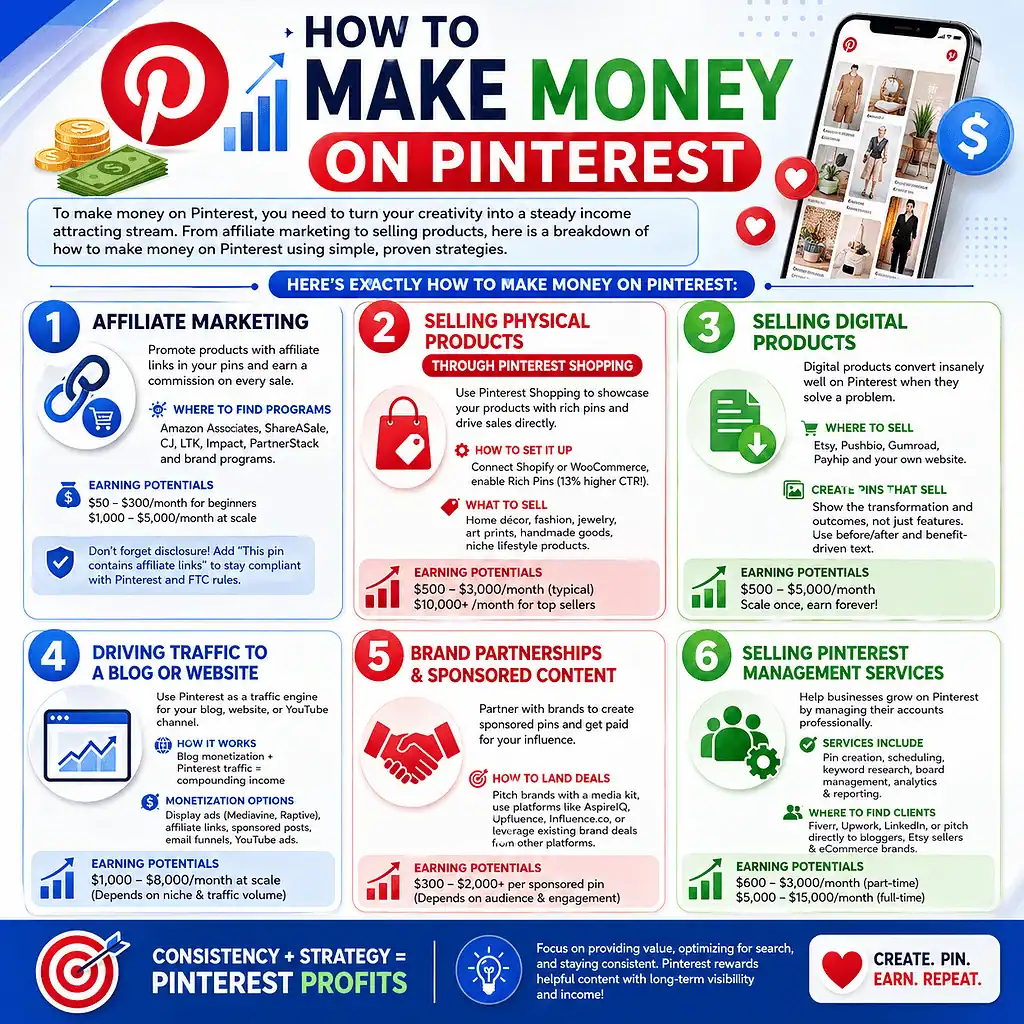
To make money on Pinterest, you need to turn your creativity into a steady income stream. From affiliate marketing to selling products, here is a breakdown of how to make money on Pinterest using simple, proven strategies. Here’s exactly how to make money on Pinterest:
1. Affiliate marketing
Affiliate marketing is the most accessible entry point for earning money on Pinterest and remains the dominant direct monetization method on the platform. It works in a simple manner; you create pins that link to products or services using a unique affiliate URL, and you earn a commission every time someone clicks through and makes a purchase.
Pinterest explicitly allows affiliate links in pins, and the platform’s search-intent audience makes it particularly well-suited for affiliate content. Unlike platforms where users passively scroll, Pinterest users are actively searching for products to solve a problem or fulfil a plan, which means a well-placed affiliate pin reaches someone at the exact moment they are ready to buy.
The most effective affiliate pins solve a specific problem or answer a specific search query. Successful Pinterest affiliate marketers do not simply promote products; they match content to search intent. A pin titled “10 Best Standing Desks Under $500” will consistently outperform a generic pin promoting a single desk, because it matches the comparison-shopping mindset of someone at the research stage of a purchase.
Where to find affiliate programs
Affiliate programs are available on several platforms, such as Amazon Associates, ShareASale, Commission Junction, LTK (formerly LikeToKnowIt), and direct brand programs, which are all popular choices for Pinterest affiliates. For specific niches like digital tools and software, Impact and PartnerStack have strong program selections.
Earning potentials
Beginners typically earn between $50 and $300 per month while building their presence. Established accounts operating in high-converting niches like home décor, fashion, finance tools, and health products can reach $1,000 to $5,000 per month with a consistent content strategy.
Disclosure requirement
Pinterest’s terms of service and FTC guidelines require you to disclose affiliate relationships clearly. A simple line in your pin description like “This pin contains affiliate links” is all that is needed, but skipping it violates platform rules and can result in account suspension.
2. Selling physical products through Pinterest shopping
Pinterest has invested significantly in its commerce infrastructure over the past two years. The platform now supports over 1.8 billion shoppable pins and has integrated directly with platforms like Shopify and WooCommerce, making it straightforward to sync your product catalogue with Pinterest’s shopping features.
For e-commerce sellers, Pinterest offers something uniquely valuable: product discovery at the inspiration stage. Because 96% of top searches on Pinterest are unbranded, a potential customer is not searching for your competitor by name; they are searching for a category or solution, which puts every seller on equal footing. A small Etsy shop selling handmade ceramics has the same shot at appearing in a relevant search result as a major retailer.
How to set it up
Connect your Pinterest business account to your Shopify or WooCommerce store to enable automatic product pin syncing. Enable Rich Pins, which pull live price and availability data directly from your product pages. Rich Pins see a 13% higher click-through rate than standard image pins.
What to sell
Home décor, fashion, jewelry, art prints, handmade goods, and niche lifestyle products perform particularly well. These are visually driven categories where a strong image can stop a scroll and inspire a purchase.
Earning potentials
With a well-stocked store and 90 or more days of consistent Pinterest activity, sellers typically reach $500 to $3,000 per month. Top ecommerce Pinterest accounts in strong niches regularly generate $10,000+ monthly.
3. Selling digital products
Pinterest converts exceptionally well for digital products, and this is one of the most underestimated income opportunities on the platform. Templates, printables, digital planners, Notion systems, mini-courses, eBooks, and design assets all sell reliably when positioned correctly.
The reason digital products work so well here is the buyer psychology. Pinterest users are planners. They are searching for organization systems, meal prep guides, budgeting templates, or fitness programs, which are the same things digital product creators make. When a pin matches a buyer’s planning intent, the sale feels natural rather than forced.
Where to sell
Etsy is the most Pinterest-compatible platform for digital products with its native checkout and strong brand trust among Pinterest’s audience. Alternatively, platforms like Pushbio can help you sell your digital products effectively on Pinterest. Also, Gumroad and Payhip are solid options for creators who want to host their own storefront without marketplace fees.
How to create effective pins for digital products
To effectively sell on Pinterest, show the transformation and not just the features of your product. A pin for a budget planner template performs better when it visually communicates “chaos to clarity” rather than simply displaying the product. Use before/after imagery or outcome-focused text overlays.
Earning potentials
Digital product sellers with strong Pinterest SEO and a well-positioned product can earn $500 to $5,000 per month. The advantage is that the product is created once and sold indefinitely, meaning income scales with content volume, not ongoing production costs.
4. Driving traffic to a blog or website
One of the most reliable Pinterest income strategies is using the platform as a traffic engine for a blog or website that is already monetized through display advertising, affiliate content, sponsored posts, or email funnels. Unlike most social platforms, Pinterest does not penalize links or throttle reach for outbound content, making it perfectly built around driving traffic to external destinations.
For bloggers, this is significant. Creating two or three pins per blog post, one image-based and one text-focused, and linking them back to the relevant article means every piece of content you publish gets a free distribution channel with a long content lifespan. A post published in 2022 can still receive regular Pinterest-driven traffic several years later if it is pinned to a well-optimized board.
How it works
Blog monetization + Pinterest traffic = compounding income
The most common setup is a niche blog monetized through Google Ads, Mediavine, or Raptive (display ads) combined with Pinterest-driven traffic. These ad networks pay per thousand page views, so increasing traffic directly increases revenue without requiring any additional product creation.
Creating a pin for each new YouTube video that links directly to the video itself means a second discovery channel for every piece of content you produce, and more views translate directly to more ad revenue.
Earning potentials
Traffic-based income depends heavily on ad network payouts and affiliate commission rates on the blog. Bloggers using Pinterest as their primary traffic source commonly earn $1,000 to $8,000 per month at scale, with income tied directly to traffic volume and niche monetization rates.
5. Brand Partnerships and Sponsored Content
Once you have built a focused, engaged audience around a specific niche on Pinterest, brands may approach you to create sponsored pins. These are contents that feature brand products or services in exchange for payment. Pinterest’s native Paid Partnership tool allows you to tag sponsored content directly within your pins, maintaining transparency with your audience while clearly signaling professional brand collaborations.
Most brands look for Pinterest creators with at least 5,000 to 10,000 engaged followers and a clearly defined content niche before commissioning sponsored work. Fees per sponsored pin range from $300 to $2,000 or more, depending on your audience size, engagement rate, and the brand’s campaign budget.
How to land brand partnerships
You can pitch brands directly with a media kit that includes your monthly impressions, click-through rates, and top-performing pins. Alternatively, influencer platforms like AspireIQ, Upfluence, and Influence.co connect Pinterest creators with brands actively seeking partnerships.
One effective approach for smaller creators is to add Pinterest as an extension of existing partnerships on Instagram or YouTube. If you already have a brand relationship on another platform, pitching an additional Pinterest deliverable is often a straightforward upsell that can meaningfully increase your total earnings per campaign.
6. Selling Pinterest management services
Pinterest management is a growing freelance service category that most guides on making money on Pinterest entirely overlook. Businesses, particularly ecommerce brands, bloggers, and service providers, consistently struggle to maintain an active Pinterest presence while running everything else. That creates demand for freelancers and virtual assistants who can manage their accounts professionally.
Pinterest management services typically include creating and scheduling pins, conducting keyword research, designing graphics, managing boards, and reporting on analytics. These services can be packaged and offered at monthly retainers ranging from $300 to $1,500 per client, depending on the scope of work.
How to get started
To start with selling Pinterest management services, build your own Pinterest account first, ideally in a niche that makes your skills visible to potential clients. Document your results as growth in impressions, clicks, and website referrals are the metrics business clients care about most. Then pitch directly to bloggers, Etsy sellers, or small ecommerce brands who are active on Pinterest but not clearly optimizing their presence.
Platforms like Fiverr, Upwork, and LinkedIn are all viable channels for finding your first clients. A single well-positioned case study or before/after growth example does more to win clients than any pitch letter.
Earning potentials
Part-time Pinterest managers handling two or three clients typically earn $600 to $3,000 per month. Full-time operators or small agencies managing 8 to 15 client accounts regularly generate $5,000 to $15,000 monthly.
How to set up your Pinterest for monetization success
To succeed on Pinterest, you’re not just creating an account; you’re building a search-optimized system. Regardless of which income method you pursue, a few foundational steps apply across every Pinterest monetization strategy:
1. Create or convert to a Pinterest Business account
The first and most important step is setting up a Pinterest Business account, not a personal one. This unlocks key features like analytics, ads, and monetization tools that are required if you want to earn money. You can either create a new account or convert an existing one without losing your followers or content. Go to pinterest.com/business/create to get started. A business account also gives you access to performance insights, such as clicks, saves, and impressions, which help you understand what’s working and scale faster.
2. Choose a clear niche and monetization direction
Before posting anything, decide what your account is about and how you’ll make money. Pinterest works best when your content is focused on a specific niche like finance, beauty, home decor, or digital products. This helps the platform understand your content and show it to the right audience. Also, decide your monetization path early, be it affiliate marketing, selling products, or driving traffic to a blog, so all your content aligns with that goal.
3. Optimize your profile for Pinterest SEO
Your profile is your first impression and a major ranking factor. Use a keyword-rich display name and bio that clearly explains who you help and what you offer. Add a professional profile picture (logo or clear headshot) and include relevant keywords in your description so Pinterest can categorize your account properly. This improves your chances of showing up in search results and attracting the right audience.
4. Claim your website
If you have a blog, store, or landing page, you should claim your website on Pinterest. This links your content directly to your profile and gives you deeper analytics about how your Pins perform. It also increases credibility, making users more likely to click your links. Claimed websites can benefit from features like Rich Pins, which automatically pull extra details like titles or product info into your Pins.
5. Set up Keyword-optimized boards
Boards act like categories for your content, and they play a big role in discoverability. Create 5–10 boards based on your niche, each with a clear name and keyword-rich description. For example, instead of “Ideas,” use something like “Budget Home Decor Ideas.” This helps Pinterest understand what your content is about and improves your visibility in search results. Organized boards also make your profile look professional and easy to navigate.
6. Learn and apply Pinterest SEO
Pinterest is not just social media; it’s a visual search engine. This means you must use keywords strategically in your:
- Pin titles
- Descriptions
- Board names
- Profile
Use the Pinterest search bar to find popular keywords and phrases people are already searching for. Additionally, research trending terms using Pinterest Trends and tools like KeySearch or Ubersuggest. When your content matches search intent, it has a higher chance of ranking and driving consistent traffic over time.
7. Create high-quality, click-worthy pins
Your content (Pins) is what actually drives traffic and income. Focus on creating visually appealing, vertical Pins (2:3 ratio) with clear text overlays and strong headlines. Pinterest favors fresh, engaging content that encourages users to click or save. You can use tools like Canva to design Pins easily. Consistency in design (colors, fonts, style) also helps build brand recognition over time.
8. Set up a consistent posting system
Consistency is key to growth on Pinterest. Instead of posting randomly, create a system where you publish Pins regularly, daily, or several times a week. This keeps your account active and increases your chances of being seen. Many successful creators use scheduling tools to plan content, ensuring they stay consistent without burnout. Over time, this builds momentum and drives steady traffic.
9. Prepare your monetization funnel
Before you start posting heavily, decide where your traffic will go. Pinterest doesn’t pay directly, which means you earn money by sending users somewhere else. This could be:
- Affiliate links
- Blog posts
- Product pages
- Email signup pages
Your Pins should always lead to a clear destination that helps you generate income. Without this setup, even high traffic won’t translate into earnings.
10. Understand analytics and track performance
Once your account is running, use Pinterest Analytics to track:
- Which Pins get clicks
- What content performs best
- Audience behavior
This data helps you double down on what works and stop wasting time on what doesn’t. Over time, this is what separates creators who make money from those who don’t.
How much can you realistically make from Pinterest?
How much you can realistically make from Pinterest depends less on followers and more on strategy, niche, and consistency. Unlike other platforms, Pinterest is a search engine, so your content can keep earning for months or years.
However, transparency about timelines matters here. Most people beginning their Pinterest income journey should plan for:
- Month 1 to 6: Building content and boards, learning SEO. Income is minimal or zero.
- Months 6 to 12: Traffic and impressions grow as the algorithm learns your content. Affiliate commissions or ad revenue begin appearing.
- Months 12 to 18: With consistent effort and a clear niche, income becomes more predictable.
- Month 18+: Compounding effects of an optimized account. Older pins keep driving traffic while new pins index faster.
Accounts with just 500 followers regularly earn over $1,000 per month if their pins rank well in search because of content relevance and search optimization. That is genuinely unusual in social media, and it is one of the platform’s most creator-friendly characteristics.
Finally
The current Pinterest system rewards patience and relevance more than any other platform. The six methods outlined here cover the full range of what is realistically available, from beginner-friendly starting points to scalable professional operations. Pick one method, set up a business account, start with keyword-driven content, and give it 90 days before evaluating results. The people consistently earning from Pinterest are not chasing virality; they are building assets that keep working quietly in the background.