

Social media strategy is no longer a one-size-fits-all decision. With dozens of platforms competing for attention and the limitations of marketing budgets, the question every creator, brand, and business has to answer is not whether to be on social media, but where. Getting that choice wrong is expensive as it means pouring creative effort and ad spend into a platform that does not match your audience, your content type, or your business goals. On the other hand, getting it right can transform how you reach customers, grow an audience, and drive revenue.
That is why understanding the difference between social platforms like Instagram and Facebook is one of the most practical decisions in digital marketing. Both platforms are owned by Meta, both reach billions of users, and both share the same underlying ad infrastructure, which can make them seem interchangeable. However, they serve fundamentally different purposes, attract different audiences, reward different types of content, and produce different results for different business models. Choosing between them or deciding how to use both requires a clear-eyed look at the data.
This article breaks down the full comparison between Instagram vs Facebook across the metrics that matter most. We will consider audience demographics, content formats, organic reach, advertising performance, ecommerce capabilities, and algorithm behavior. The goal is to provide you with a specific, evidence-based answer to which platform is right for your particular situation.
Instagram vs Facebook: The scale of each platform
Before comparing what each platform does, it helps to understand how large they actually are.
- Facebook remains the world’s largest social network with approximately 3.07 billion monthly active users as of 2025, reaching around 34.1% of the global adult population. Its top user bases are in India (581.6 million users), the United States (279.8 million), and Brazil (175.1 million).
- Instagram has grown to approximately 2.4 billion monthly active users, making it the fourth-largest social platform globally. India leads Instagram usage with 385 million users, followed by the United States at 166 million and Brazil at 135 million.
Both numbers are huge. However, raw user count is not the same as audience quality, engagement, or reach for your specific content. For most businesses, the more important question is not which platform has more users, but which platform has more of your users, and whether those users behave in ways that support your goals.
Instagram vs Facebook: Which platform should you focus on?
Choosing between Instagram and Facebook isn’t about which is “better,” it’s about which fits your goals, audience, and content style.
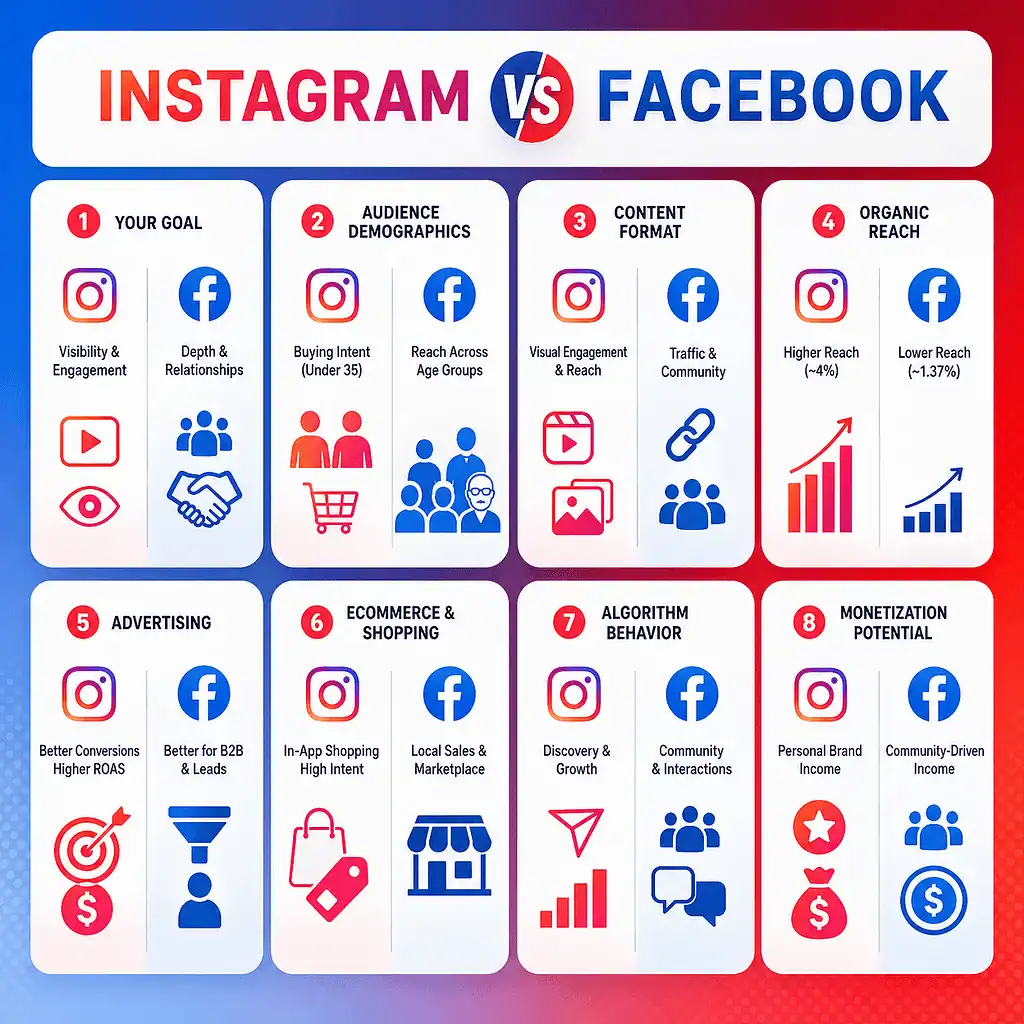
Here’s a clear, practical breakdown to help you decide:
1. Your goal matters
Understanding your goal is the foundation of choosing between Instagram and Facebook. Each platform is designed to achieve different outcomes, so your objective should guide your decision.
Facebook is structured for depth and connection. It excels in community-building through Groups, long-form posts, and discussions. The platform is particularly strong for reaching older audiences and local communities, making it ideal for businesses that rely on trust, relationships, and ongoing engagement rather than quick visibility.
Instagram is built for fast-paced growth and visibility. The platform thrives on short-form video (Reels), eye-catching visuals, and trend-driven content. It is especially effective for building a personal brand, where your personality, creativity, and consistency can quickly attract attention. If your strategy involves storytelling through images and videos, Instagram provides the tools and algorithmic support to scale quickly.
Verdict
Instagram for visibility and engagement, Facebook for depth and relationships.
Instagram drives fast attention through visual content, while Facebook builds stronger, long-term connections through community interaction.
2. Audience demographics
Facebook’s audience is significantly older than Instagram’s. Data shows that males aged 25 to 34 make up the largest single demographic segment, but the platform has strong penetration across every age group, including 35 to 54 and 55-plus. This breadth is one of Facebook’s real advantages: if you need to reach parents, decision-makers, professionals aged 35 and above, or a truly multigenerational audience, Facebook is unmatched.
It is also the dominant platform for community activity. Facebook Groups attract over 1.8 billion users per month, and the platform’s algorithm has pivoted back toward community-first engagement by prioritizing Groups, Events, and local discovery over broadcast-style page posts.
Instagram’s audience skews significantly younger. The dominant user segments are aged 18 to 24 and 25 to 34, collectively representing the core of the Millennial and Gen Z demographic. The platform also attracts a slightly female-leaning global audience.
What makes Instagram’s demographics particularly valuable for marketers is not just age but intent. According to Sprout Social’s 2025 data, 55% of Instagram users say they specifically use the platform as a place to shop. Around 61% of users discover products on Instagram, making it the top platform for product discovery. If your audience is under 35 and your product is visual, Instagram’s user base has purchase behavior built into how they use the platform.
Verdict
Instagram for buying intent, Facebook for reach across age groups.
Facebook wins for broad, older, and community-driven audiences, especially if you’re targeting professionals, parents, or local markets. Instagram wins for younger, purchase-ready users, especially under 35, and for visual products.
3. Content format
This has to be the most fundamental difference between the two platforms, and understanding it will save you from creating the wrong content for the wrong audience.
Facebook supports a wider variety of content types than Instagram. Creators can leverage text posts, image posts, link posts, video, live streaming, Stories, Reels, and long-form content through Notes. One major thing to note here is that links work on Facebook. This means posts can include clickable outbound URLs, which makes it a strong platform for driving traffic to websites, blogs, and landing pages.
Several data show that consumers on Facebook are more likely to interact with text posts than on any other major platform. Text-based posts with colorful backgrounds, in particular, have been shown to receive strong algorithmic reach on Facebook and outperform generic image posts.
Additionally, Facebook’s Groups and Events features remain genuinely distinctive. No Instagram equivalent builds the same kind of community infrastructure. If your strategy involves community building, member communication, or local business marketing, Facebook’s community tools have no real parallel on Instagram.
Instagram was built as a photo platform and has evolved into a video-dominant, mobile-first experience. More than 98% of Instagram’s ad impressions are served on mobile devices. The platform’s content hierarchy is clear: Reels receive 36% more reach than other post types, generating more than double the reach of single-image posts and 1.36x more than carousels.
Static image posts on Instagram are declining in organic visibility unless boosted by paid spend or influencer tags. Stories remain valuable for behind-the-scenes content and audience engagement, but do not contribute to broad discovery. The platform is now effectively built around Reels for reach and Stories for relationship maintenance. Also, carousels serve as the most save-worthy format for evergreen educational content.
One notable limitation of Instagram is that it only allows a limited number of clickable links in your bio. This means it is a poor platform for directly driving traffic to blog posts or product pages unless you are running paid ads. If link traffic is a key metric for your business, this single constraint tips the balance toward Facebook.
Verdict
Facebook for traffic + community, Instagram for visual engagement + reach.
Facebook is more flexible and link-friendly, making it ideal for traffic, long-form content, and community tools like Groups. Instagram is visual-first and video-driven, with Reels dominating reach and performance.
4. Organic reach
Historically, both Facebook and Instagram have significantly reduced organic reach for business accounts over the past five years, but they have done so differently. The practical implication for most businesses is that both platforms increasingly require paid promotion to deliver meaningful reach from business accounts. This is not an algorithmic accident but a deliberate platform strategy to monetize the reach that used to be free.
Organic reach on Facebook for business pages currently averages approximately 1.37%, according to 2025 benchmark data. This means a page with 10,000 followers can expect roughly 137 people to see any given post organically. Facebook’s algorithm deprioritizes brand page content in favor of posts from friends, family, and Groups, and that bias has intensified, not relaxed.
For Instagram, organic reach averages around 4%, which is meaningfully better than Facebook’s, though it has fallen 18% year-on-year. However, Reels on Instagram provide a significant exception. Instagram Reels are actively distributed to non-followers, giving even small accounts a genuine pathway to new audiences without paid promotion.
Verdict
Instagram clearly wins for organic growth.
Facebook organic reach is extremely low (~1.37%) unless you use Groups or paid ads. Instagram has better reach (~4%), with Reels offering strong discovery to non-followers.
5. Advertising
Both platforms use the same underlying Meta ad infrastructure, which means you can build audiences, run campaigns, and manage spend through Meta Ads Manager for both simultaneously. But their ad performance characteristics differ in meaningful ways.
Click-Through and Conversion Rates
Instagram ads generate an average conversion rate of 1.85%, compared to Facebook’s 1.62%. Instagram’s average cost per click is approximately $2.50, slightly below Facebook’s $2.85 CPC. These differences favor Instagram for direct conversion campaigns, particularly for visual products where the creative strength of the platform format (Reels, Stories, Shopping ads) can be leveraged.
Return on Ad Spend (ROAS)
Facebook’s average ROAS across all verticals sits at approximately 2.98, while Instagram’s ROAS averages around 4.2:1 for ecommerce and visual product campaigns. The differential is significant enough to matter at scale. For instance, for every $10,000 spent on Instagram ecommerce ads versus Facebook, the average expected return is meaningfully higher on Instagram for the right product categories.
That said, Facebook significantly outperforms Instagram for B2B advertising. Professional demographics, a business-focused user mindset, and the ability to run highly specific job title and company-size targeting make Facebook the clearer choice for lead generation and B2B campaigns.
Cost per Acquisition (CPA)
Average CPA benchmarks in 2025 show Instagram at $32 per acquisition for lifestyle and fashion products, compared to Facebook’s $38 per acquisition for broader demographic targeting. Instagram’s lower CPA for visual products is one of the clearest data arguments for investing in Instagram ads for e-commerce.
A practical starting strategy for businesses running campaigns on both platforms is a 50/50 budget split during the testing phase, then allocating more toward the platform showing better ROAS and CPA performance for your specific product and audience.
Verdict
Instagram for e-commerce, Facebook for B2B, and leads.
Instagram delivers better conversions, lower CPA, and higher ROAS for visual and e-commerce products. Facebook performs better for B2B, lead generation, and precise targeting.
6. E-commerce and shopping features
Both platforms have invested heavily in social commerce, but Instagram has a clear edge for most e-commerce brands.
Instagram Shopping
Instagram’s shopping features allow businesses to tag products directly in feed posts, Reels, Stories, and carousels. Products link to in-app shopping pages with descriptions, pricing, and checkout options. This keeps the entire purchase journey within Instagram. Instagram has expanded its shoppable pin features and integrated AI-powered style matching to surface visually similar products to high-intent shoppers.
Facebook Shops
Facebook offers a similar product catalogue experience and is connected to Marketplace, which is particularly strong for local businesses and second-hand goods. Facebook’s Marketplace alone attracts over 1 billion monthly users and makes it a major channel for local retail, real estate, and community-based buying and selling.
For most brands and e-commerce businesses with visual products, Instagram’s shopping infrastructure, combined with its higher purchase intent audience, makes it the primary social commerce platform. For local businesses, service providers, and community-focused retail, Facebook’s Marketplace and Groups-based commerce tools are often more directly applicable.
Verdict
Instagram for online stores, Facebook for local and service-based sales.
Instagram dominates with in-app shopping, product tagging, and high purchase intent. Facebook is stronger for local selling via Marketplace and community commerce.
7. Algorithm behavior
Understanding how each algorithm distributes content is as important as understanding the audience.
Facebook’s algorithm prioritizes content from Groups and active personal connections over brand page posts. Also, content that earns DM shares (sends) is heavily rewarded, as Facebook has signaled that private shares are the strongest signal of content value in its system. Long-form video and live content also perform well.
Brand pages that want organic reach on Facebook need to either run paid promotion or invest in building active Groups rather than relying on page post distribution. Facebook’s algorithm is increasingly focused on deepening engagement within existing communities rather than broad discovery for business pages.
Instagram’s algorithm prioritizes Reels for broad reach and measures “sends per reach” (how often a post is shared directly to others) as its top engagement signal, ahead of saves. Reciprocal engagement (comments and replies) also carries significant weight.
The algorithm strongly favors original content as Instagram has explicitly stated it deprioritizes reposted or watermarked content (particularly recycled TikToks), and the platform rewards accounts that post consistently using native formats. It’s also important to note that Instagram’s algorithm actively distributes content to non-followers, making it a genuine discovery platform for growing audiences.
Verdict
Instagram for discovery and growth, Facebook for community depth.
Facebook prioritizes Groups and private interactions, limiting brand page reach. Instagram prioritizes Reels, shares (DMs), and discovery, making it growth-friendly.
8. Monetization potential
Both Instagram and Facebook offer strong earning opportunities, but they operate through different monetization models.
Facebook’s monetization is more community-driven and utility-based. Income often comes from paid Groups, Marketplace sales, and driving traffic to external platforms like blogs or landing pages. It is particularly effective for local businesses, service providers, and creators who build loyal communities and monetize through ongoing engagement rather than one-off visibility.
Instagram is optimized for personal brand monetization. Creators earn through brand deals, influencer marketing, and selling digital products. Because the platform is highly visual and discovery-driven, it is easier to attract attention from brands and audiences willing to buy. This makes Instagram especially powerful for creators, influencers, and online entrepreneurs who rely on visibility and audience trust to generate income.
Verdict
Instagram for personal brand income, Facebook for community-driven income.
Instagram monetizes attention and influence, while Facebook monetizes relationships and long-term audience trust.
Instagram vs Facebook: Which platform wins by business type?
There is no universal answer to whether Instagram or Facebook is better. The right platform depends entirely on who you are trying to reach and what outcome you are optimizing for.
| Business Type | Primary Platform | Reason |
| DTC / ecommerce (visual products) | Higher purchase intent, Shopping features, visual discovery | |
| B2B / professional services | Facebook (+ LinkedIn) | Professional targeting, longer-form content, lead gen tools |
| Local businesses | Groups, Marketplace, Events, local targeting | |
| Fashion, beauty, lifestyle brands | 18–34 demographic, Reels reach, influencer ecosystem | |
| Community organizations / NGOs | Groups infrastructure, Events, community management tools | |
| Food and restaurant brands | Both | Facebook for local discovery; Instagram for visual food content |
| Creator economy / personal brand | Reels-driven discovery, influencer tools, younger audience | |
| 35+ audience targeting | Demographic reach, age group penetration |
Can I use Instagram and Facebook together?
Yes, you can use both Instagram and Facebook together as it’s actually one of the smartest ways to grow faster online. The strongest social media strategies treat Instagram and Facebook as complementary, not competing.
Since both platforms share Meta’s ad infrastructure through Meta Business Suite, cross-platform campaigns focused on targeting the same audience across both platforms simultaneously will consistently outperform single-platform campaigns.
The most efficient content approach is to create content natively for Instagram (Reels-first, visual, short-form) and adapt it for Facebook. Carousel posts that work on Instagram cannot be used for organic Facebook posts in the same format. Captions that reference Instagram-specific features (like “swipe” instructions) create a disjointed experience when they appear on Facebook.
What works best is for creators to treat Instagram as their discovery and acquisition engine for finding new audiences through Reels, influencer content, and product discovery. At the same time, they should treat Facebook as their community and retention engine, where Groups, Events, and targeted advertising deepen relationships with existing customers and reach older demographics.
Which should I use: Instagram or Facebook?
Choosing between Instagram and Facebook ultimately comes down to three questions:
- Who is your customer? If they are primarily under 35 and purchase-intent driven, Instagram. If they are over 35, community-oriented, or in a professional context, Facebook.
- What is your content format? If your product is inherently visual and short-form video works well for it, Instagram. If your strategy involves text, links, long-form education, or community discussion, Facebook.
- What is your primary goal? If it is product discovery and direct ecommerce conversion, Instagram has the data advantage. If it is community building, local marketing, B2B lead generation, or reaching a broad demographic, Facebook is the better foundation.
Final verdict
For most businesses, brands, and creators, the answer is not either here nor there. The best answer is to leverage both simultaneously by using Instagram-first to capture newer audiences and then Facebook for community and advertising reach. Creators can build their organic content strategy around Instagram’s Reels-driven discovery model, run cross-platform campaigns through Meta Ads Manager, and maintain an active Facebook presence for community engagement, local targeting, and capturing the 35-plus demographic your Instagram strategy is less likely to reach.