

TikTok may look like organised chaos from the outside with trends erupting overnight, unknown creators suddenly amassing millions of views, and a feed that somehow always knows exactly what you want to watch next. But none of that is random. Behind every viral video is a recommendation engine making thousands of micro-decisions about who sees your content, for how long, and whether it gets pushed to a wider audience. Understanding that the system is no longer optional for anyone serious about growing on the platform.
The TikTok algorithm is a machine-learning recommendation system that determines which videos appear on each user’s For You Page (FYP). According to TikTok’s own documentation, it analyses user interactions, video information, and account settings to serve highly personalized content feeds, thereby ensuring that no two users ever see the same FYP. A brand-new account with zero followers has the same algorithmic access to millions of screens as an account with ten million followers if the content earns the right signals. That is the core principle that makes TikTok the most democratized large social platform in existence today.

To help creators, brands, and marketers leverage this platform, we have created a detailed guide on ways to beat the TikTok algorithm. You will get a precise breakdown of how the TikTok algorithm works, the most heavily weighted ranking signals, specific content strategies that consistently drive FYP placement, what the platform’s 2025 algorithm update changed, and proven tips for turning data into better content decisions.
How the TikTok algorithm works: The core mechanics
The TikTok algorithm works on a trial-and-error basis. The algorithm recommends a video and then learns from the user’s engagement with the content. Newly posted videos are test-run by showing them to a small group of users, whose engagement with the video determines whether it gets rolled out to a more diverse audience.
Think of it as a tiered distribution system. Your video starts small, shown to a seed audience that TikTok believes will find it relevant based on its content signals. If that group engages strongly, TikTok expands distribution to a larger related audience. Strong performance there triggers another expansion.
This cycle continues until engagement drops below a threshold, at which point the algorithm stops amplifying the video. Most videos never make it past the first tier. Viral videos pass through multiple expansion cycles with sustained engagement at each stage.
The three ranking signal categories
TikTok’s algorithm evaluates content using three primary signal categories:
1. User Interactions
What viewers watch, like, comment on, share, save, replay, or skip. Watch time and video completion rate carry the most weight. A rewatch or share may signal a stronger interest than a like or follow, and could result in your video being tested with a larger audience.
2. Video Information
Captions, hashtags, sounds, on-screen text, and effects. TikTok uses speech recognition, text analysis, and visual cues to understand video content, even without hashtags contextually.
3. Account and Device Settings
Language, country, device type, and preferences. These are weaker signals than the first two categories, but they help TikTok personalize localized content delivery.
What TikTok explicitly does not consider
TikTok says it won’t give creators a boost based on past performance. Someone with a high follower count and previously viral videos won’t get preferential rankings over a smaller account with more relevant content. This is the algorithm’s most creator-friendly characteristic and the reason niche accounts regularly outperform mega-influencers on relevant content.
What changed in the last TikTok algorithm update?
The 2025 TikTok algorithm update introduced meaningful changes that every creator needs to understand.
TikTok has introduced a micro-niche push strategy, meaning that the first people who see a new video are now part of a highly targeted audience. The updated TikTok algorithm matches the video to the most relevant interest group. Based on these factors, the video is shown to interest groups that have already shown strong engagement with similar content. If the video performs well in these groups, it is then shown to related communities.
The practical implication is that broad, generic content is harder to amplify now than it was two years ago. The TikTok algorithm in 2025 is built around communities, not random viral hits.
The update also shifted the weighting toward what TikTok calls “meaningful engagement,” like saves, shares, full video completions, and profile visits over shallow interactions like passive likes. A video with 500 saves will outperform a video with 5,000 likes in terms of algorithmic distribution.
9 Proven strategies to beat the TikTok algorithm
The TikTok algorithm rewards content that keeps people watching, interacting, and coming back for more. To beat it, creators need to focus on high watch time, strong engagement, consistent posting, and using trends strategically. Combining several of these strategies together lets your content have a much higher chance of reaching the For You page and growing your audience.
1. Engineer your hook for the first 3 seconds
The “3-second rule” is TikTok’s shorthand for the fact that you only have three seconds to hook viewers. If you can keep viewers engaged beyond three seconds, your chances of ranking on the FYP rise significantly.
Your hook must do one of three things immediately: create curiosity, create tension, or deliver instant value (“Here’s the fastest way to do X”). The hook is not a warm-up. It is the entire first impression.
2. Maximize watch time and video completion rate
Completion rate is the strongest individual signal in TikTok’s ranking system. A video watched to the end and especially re-watched tells the algorithm that the content delivered on its hook. Strategies that improve completion rate include: strong narrative arcs that delay the payoff, multi-part series that create anticipation, on-screen text countdowns, and ending with a call to action that invites comment or replay.
While there’s no ideal duration for every video, many viewers find videos longer than one minute to be stressful, so it’s safer to keep them under 60 seconds. For most niches, 15–45 seconds remains the highest-completion bracket.
3. Use trending audio strategically
Songs and sounds often explode in popularity on TikTok. When a sound starts trending, using it creatively taps you into an audience already engaged with that audio. The keyword is “creatively” as adding trending audio to content that has no natural connection to it reads as forced and drives up skip rates.
Viral songs have become increasingly associated with specific trends or types of content. If a song is overwhelmingly used in one context, viewers may have built an expectation about what the video will be. Once viewers have seen enough content using a particular song, the music itself becomes a hook. Use trending audio when it genuinely fits your content and adds meaning.
4. Optimize for TikTok SEO
Search engine optimization isn’t just for Google, with TikTok quickly becoming a popular search engine in its own right. TikTok’s search function is increasingly how users discover content, particularly among Gen Z.
Keyword research on TikTok is straightforward: type your core topic into the search bar and study the autocomplete suggestions. Those are your audience’s actual search terms. Embed those keywords naturally in your caption, in on-screen text, and in spoken audio. This is because TikTok’s speech recognition indexes what you say, not just what you type.
5. Post consistently but prioritize quality
Many creators agree that posting 3 to 5 times a week is a sweet spot for most accounts. Consistency helps the algorithm learn your style, but quality still matters. This means it is better to skip a day than to rush out a weak video.
TikTok data shows high-quality videos get 40x follower growth compared to low-quality uploads. That figure makes the quality-versus-quantity trade-off clear. Three strong videos a week will consistently outperform seven mediocre ones.
6. Tap into TikTok subcultures and communities
Connecting with existing communities is more important on TikTok than on other social networks. TikTok users are four times more likely to say that TikTok is the best platform for being part of a community.
TikTok subcultures like BookTok, FoodTok, or FinTok are established audiences that actively engage with niche content. Creating content that speaks to one of these communities gives your video a ready-made, highly engaged audience to test with during the first distribution wave. Tap into an existing TikTok subculture, and you will likely find your content amplified to that audience far faster than broad, niche-agnostic content.
7. Trigger ‘Saves’ and ‘Shares’
To increase your reach, you need to signal two things to the algorithm: relevance and retention. Focus on creating content that keeps users watching past the 5-second mark for “Qualified Views” and encourages them to save or share the video.
Design content with save triggers built in: tutorial content people want to reference later, data or statistics worth bookmarking, lists of resources, or step-by-step guides. Share triggers come from emotional resonance or strong relatability. If your content makes someone think “I need to send this to someone,” they are more likely to do so. Both saves and shares are high-weight signals that accelerate distribution far more effectively than passive likes.
8. Post at peak engagement times
Timing is not the strongest ranking factor, but it influences the quality of the initial seed audience that receives your video in the first hour. Late afternoons and evenings (6–9 PM local time) generally perform best.
TikTok does not penalize content posted at “off” hours, but early engagement can influence reach during the initial testing phase. Use TikTok Analytics to identify when your specific audience is most active. That data will be more reliable than any general benchmark.
9. Use the edutainment formula
The most consistent path to virality on TikTok is the edutainment formula: delivering value (education) in an entertaining format. Videos that go viral typically have a strong hook, offer high search value, and are under 90 seconds. The goal is to trigger the share button; if people feel compelled to send your video to a friend, the algorithm will push it to thousands more.
Edutainment content that teaches while entertaining earns both saves (because it is useful) and shares (because it is engaging). It is the single format that consistently over-indexes across multiple TikTok niches.
What the TikTok algorithm penalizes
There are types of content that TikTok will de-rank in the FYP. These include misleading content, clickbait, and deceptive engagement tactics.
Beyond policy violations, avoid these common algorithmic mistakes:
1. Reposting low-quality content
TikTok discourages content that appears recycled from other platforms. Videos that contain visible watermarks from apps like Instagram Reels or other editing tools are less likely to be promoted by the algorithm. The platform prioritizes original content created specifically for TikTok. When the system detects a watermark or duplicated video, it may limit how widely the clip appears on the For You page.
2. Very short watch time and early drop-offs
Watch time is one of the strongest signals TikTok uses to evaluate content quality. If viewers scroll away from a video within the first few seconds, the algorithm interprets this as a sign that the content is not engaging. Videos with high completion rates or repeat views are more likely to be recommended to larger audiences. When most viewers leave early, the platform reduces distribution because it assumes the content is not keeping people interested.
3. Violating community guidelines
TikTok strictly enforces its Community Guidelines, and content that breaks these rules can be heavily penalized. Videos that include harmful behavior, misinformation, dangerous activities, hate speech, or explicit material may be removed or restricted. Even borderline content can reduce a creator’s visibility. Repeated violations can lead to limited reach, temporary restrictions, or account suspension. Staying within the platform’s rules helps maintain consistent visibility and protects the account from algorithmic penalties.
4. Misleading captions, hashtags, or metadata
Using unrelated hashtags or deceptive captions to attract views can hurt performance over time. The TikTok algorithm analyzes video content, captions, sounds, and hashtags together to understand what the video is about. When tags do not match the actual content, the system struggles to categorize the video correctly. This confusion often leads to reduced distribution because the algorithm cannot confidently recommend the content to the right audience.
5. Posting spammy content
Accounts that repeatedly post sales-heavy or spam-like content may experience reduced reach. TikTok favors entertaining, informative, or engaging videos rather than constant advertisements. When every video pushes a product or includes repetitive promotional messages, viewers may interact less with the content. Lower engagement signals tell the algorithm that people are not interested, which results in fewer recommendations on the For You page and slower audience growth.
6. Deleting underperforming videos
Deleting videos can negatively impact your account. It removes data points the algorithm uses to understand your content, and mass-deleting can trigger spam filters. Instead, change the video’s privacy settings to “Only Me.”
Using TikTok Analytics to refine your strategy
Every TikTok creator account has access to native analytics.
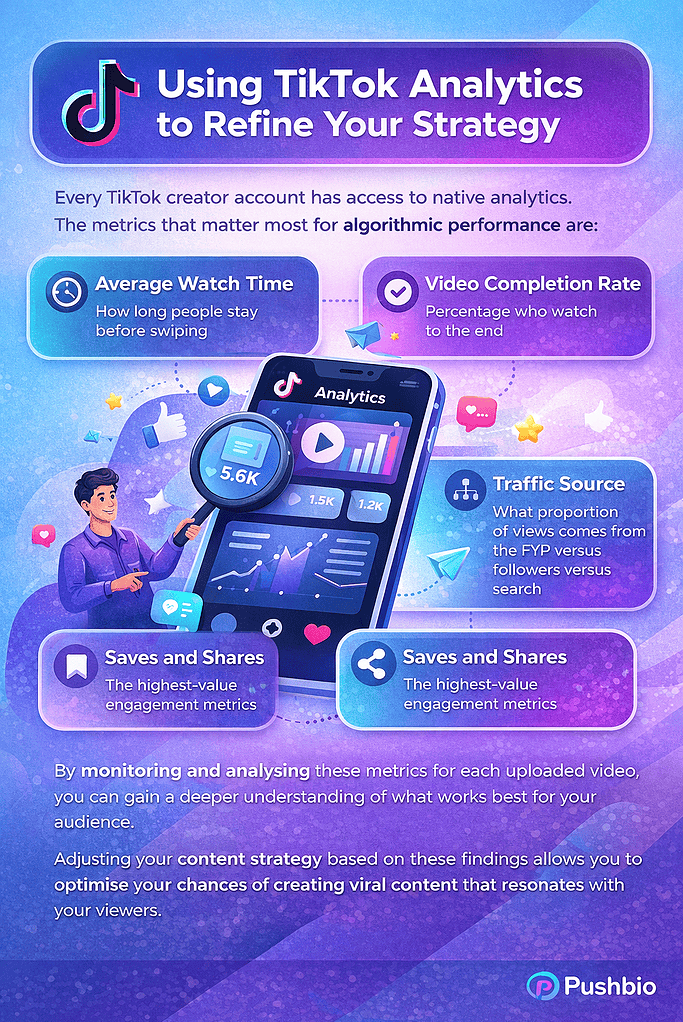

The metrics that matter most for algorithmic performance are:
- Average Watch Time: How long people stay before swiping
- Video Completion Rate: Percentage who watch to the end
- Traffic Source: What proportion of views comes from the FYP versus followers versus search
- Saves and Shares: The highest-value engagement metrics
By monitoring and analyzing these metrics for each uploaded video, you can gain a deeper understanding of what works best for your audience. Adjusting your content strategy based on these findings allows you to optimize your chances of creating viral content that resonates with your viewers.
For multi-account management and deeper performance data, tools like Pushbio, Sprout Social, and Buffer all offer TikTok analytics dashboards that surface patterns across your content history. This can be useful for identifying which content pillars consistently earn FYP traffic.
In the end
To beat the TikTok algorithm does not require rigorous or technical hacks or tricks. The algorithm is built to surface content that real people genuinely want to watch, which means the most reliable path to viral content is simply making something worth watching. A strong hook, high completion rate, meaningful engagement signals, and consistent niche identity are the four pillars that the algorithm consistently rewards.
Additionally, creators can leverage the edutainment formula, optimize for saves and shares over passive likes, build their content around a specific community rather than a broad audience, and let their analytics tell them what is working.